
Vertex CampusOS
Multi-Tenant University Operations & Student Governance Platform
“How do you build a campus operating system that replaces scattered WhatsApp groups and manual spreadsheets?”
Case Study Index (6 Sections)↓
Overview & Motivation
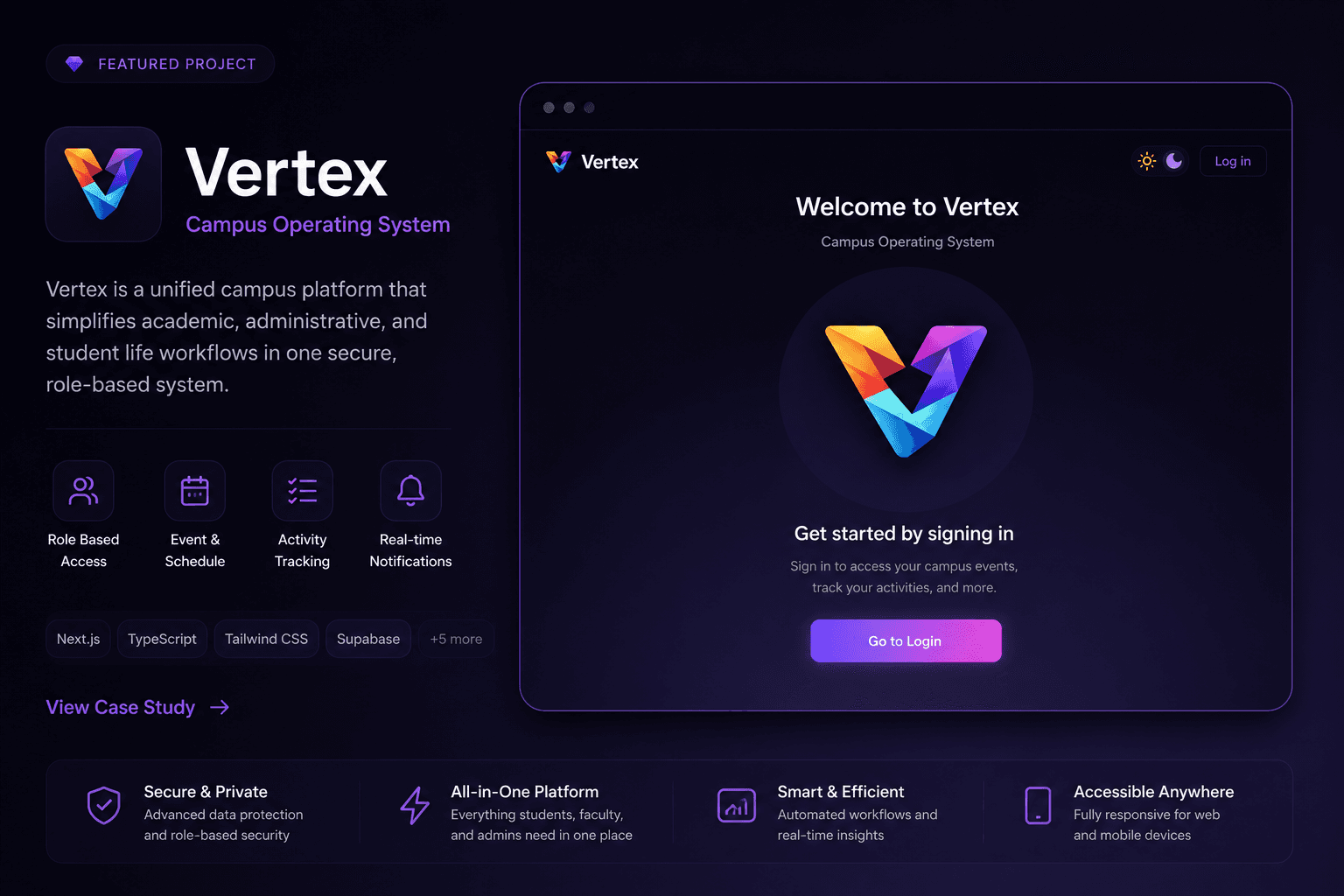
Campus administration in universities often relies on fragmented tools—WhatsApp groups for announcements, physical paper for On-Duty (OD) approvals, and offline spreadsheets for attendance tracking. Vertex CampusOS unifies these disjointed operational streams into a multi-role operating platform built on Next.js and Supabase.
During my time at university, tracking club event signups and managing attendance approvals required physical signatures and endless group messages. I wanted to build a single system where every campus workflow had a clear, verifiable digital path.
Platform Architecture
Built on a decoupled model separating the responsive client layer, authentication boundary, and relational persistence. Employs fine-grained RLS at the database layer.
Platform Modules
Student Directory
Centralized enrollment records, profile verification, and registration status.
Club Governance
Event creation, registration tracking, and budget allocation workflows.
Attendance System
Automated class rosters with faculty verification controls.
Digital OD Approvals
Multi-stage approval state machine for On-Duty leave requests.
Engineering Decisions & Tradeoffs
Managing club and student permission logic inside API routes led to duplicate checks and authorization leak risks.
Configured PostgreSQL Row-Level Security (RLS) policies bound to user auth roles, ensuring queries automatically filter data at the database layer.
Policy evaluation adds slight overhead to complex queries, requiring indexed policy keys.
Guaranteed zero multi-tenant data leakage between student clubs and department admins.
Club leads and students frequently experienced out-of-sync registration counts when managing high-traffic event signups.
Integrated Supabase real-time websocket listener channels into local React state hooks.
Increased active WebSocket connection count during event windows.
Achieved sub-100ms dashboard updates across active administrative panels.
Challenges & Security Notes
Employs PostgreSQL RLS policies ensuring students access only their own records, club leaders view only their club rosters, and admins retain system audit capability.
Role-Based Access Control Surface Area
Issue: Admins, club leaders, and students required vastly different user interfaces without code duplication.
Decision/Solution: Architected modular layout containers fed by a unified capabilities contract rather than rendering separate app routes.
Development Timeline
Architecture & Schema Design
Modeled database tables and RLS policy rules.
Core Attendance & Club Modules
Built student event registration and class roster engines.
Digital OD Approval Pipeline
Shipped multi-tier state machine for faculty approvals.
Production Showcase Release
Deployed flagship platform with live demo environment.
What's Next
Key Takeaways
Pushing authorization to database RLS policies prevents entire classes of client-side security leaks.
Designing around real organizational workflows requires understanding user permission matrices before writing code.
Real-time WebSocket streams drastically simplify state management for multi-user dashboards.
Related Engineering Projects
SRM Academic Suite
Built a deterministic CGPA/SGPA grade calculator and target optimization tool used by student peers, featuring PDF report parsing.
Splitzy
Built an offline-first financial ledger featuring integer-paise precision, append-only event logs, and PL/pgSQL database triggers to prevent floating-point rounding bugs.